- Go 100%
|
|
||
|---|---|---|
| build | ||
| screenshots | ||
| .gitignore | ||
| color.go | ||
| flock.go | ||
| LICENSE | ||
| main.go | ||
| markov.go | ||
| optionManualTweetFromFlock.go | ||
| optionMarkovFlockBotnet.go | ||
| optionTweetMarkov.go | ||
| readConfigTokensAndConnect.go | ||
| README.md | ||
| readTxt.go | ||
| text.txt | ||
| waitTime.go | ||

flock-botnet 
A twitter botnet with autonomous bots replying tweets with text generated based on probabilities in Markov chains
generating text with Markov chains
Markov chain: https://en.wikipedia.org/wiki/Markov_chain
The algorithm calculates the probabilities of Markov chains, analyzing a considerable amount of text, for the examples, I've done it with the book "The Critique of Pure Reason", by Immanuel Kant (http://www.gutenberg.org/cache/epub/4280/pg4280.txt).
Replying tweets with Markov chains
When the botnet is up working, the bots start streaming all the twitter new tweets containing the configured keywords. Each bot takes a tweet, analyzes the containing words, and generates a reply using the Markov chains previously calculated, and posts the tweet as reply.
In the following examples, the bots ("andreimarkov", "dodecahedron", "projectNSA") are replying some people.
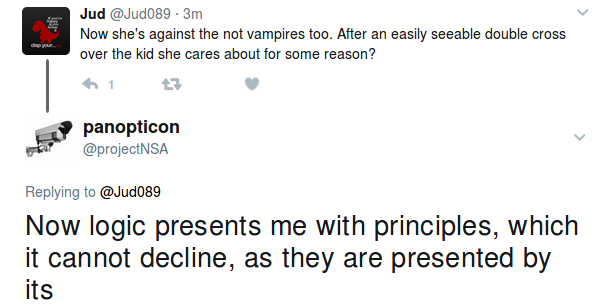

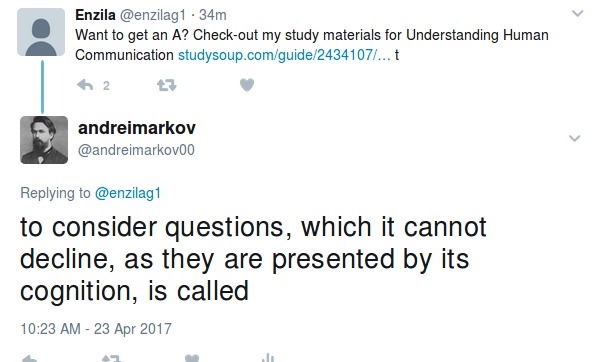
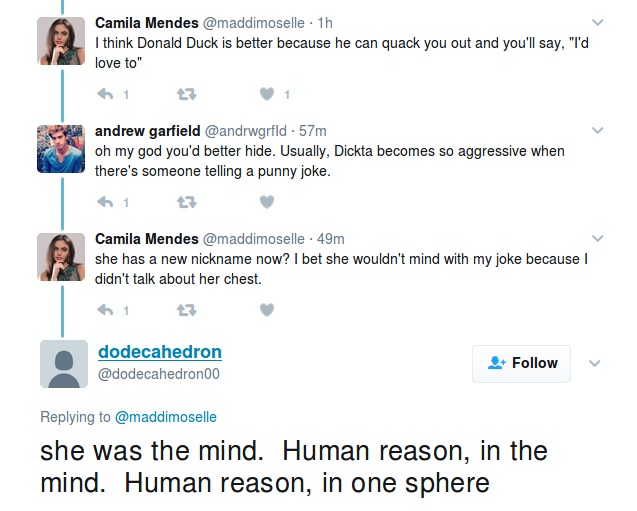
configuration file example (flockConfig.json):
[{
        "title": "account1",
        "consumer_key": "xxxxxxxxxxxxx",
        "consumer_secret": "xxxxxxxxxxxxx",
        "access_token_key": "xxxxxxxxxxxxx",
        "access_token_secret": "xxxxxxxxxxxxx"
    },
    {
        "title": "account2",
        "consumer_key": "xxxxxxxxxxxxx",
        "consumer_secret": "xxxxxxxxxxxxx",
        "access_token_key": "xxxxxxxxxxxxx",
        "access_token_secret": "xxxxxxxxxxxxx"
    },
    {
        "title": "account3",
        "consumer_key": "xxxxxxxxxxxxx",
        "consumer_secret": "xxxxxxxxxxxxx",
        "access_token_key": "xxxxxxxxxxxxx",
        "access_token_secret": "xxxxxxxxxxxxx"
    }
]